Newly Measured Outcrops Allow for Updated Biostratigraphy of Cauvery Basin
By Informatics @ EGI in News
January 16th, 2021


Dr. Sudeep Kanungo describes his recently published research, adding to our understanding of Cauvery Basin geology.
Why we did it?
The Cauvery Basin is an important Mesozoic depocenter of southern Asia (India) with a well-developed Cretaceous marine sedimentary succession and paleontological diversity. The basin is known for its Cretaceous petroleum system and has been commercially explored for hydrocarbons. This calls for continuously improving the stratigraphic constraints and correlation of the basin using the best possible chronostratigraphic resolution.
What did we do?
We have upgraded the Albian to Turonian calcareous nannofossil biostratigraphy of the Cauvery Basin using two newly measured outcrop sections and tied it with recently published ammonite stratigraphy (Gale et al., 2019), offering a higher resolution than obtained previously. In this manner, two of the best-known Cretaceous fossil groups, i.e., calcareous nannoplankton and ammonites, have been tied together to produce a robust biostratigraphy of the basin.
What did we find?
- This work is an important contribution to the geology of the Cauvery Basin.
- The applicability of calcareous nannofossil markers have been rigorously tested and compared with other basins; some markers worked well, while others did not, and proved to be problematic.
- The Albian-Cenomanian boundary appears to be stratigraphically continuous in the two sections, without significant breaks.
- The Cenomanian-Turonian boundary is incomplete in the basin with a hiatus of the order of ~0.66 Myrs.
- From a biogeographic perspective, the Cauvery Basin nannoplankton displayed a fairly muted Austral character, as the assemblages were found to be dominated by broadly cosmopolitan taxa during the Albian-Turonian interval.
- Four new calcareous nannofossils species are described and illustrated, along with other species recovered from the basin.
Highlights
- High-resolution Cretaceous biostratigraphy established for the Cauvery Basin using calcareous nannofossils and ammonites.
- The FO of Gartnerago ponticulais proposed as a new nannofossil proxy for approximating the Albian-Cenomanian boundary.
- A Cenomanian-Turonian boundary interval hiatus equivalent to Nannofossil Zone UC5 is present with a magnitude of ~0.66 Myrs.
- The Austral character of the Cauvery Basin nannoplankton assemblages is suppressed.
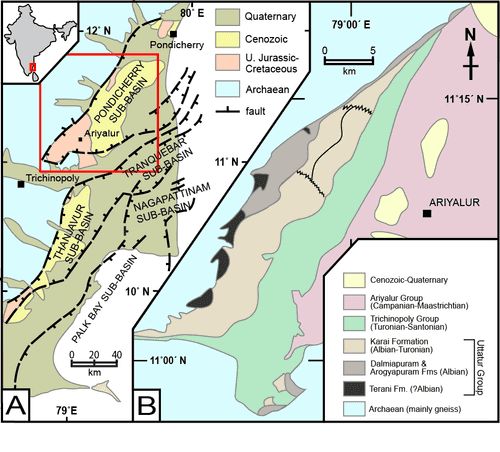
Study area, adapted from Kanungo et al., 2021
Abstract
A suite of outcrop samples from the Cauvery Basin belonging to the mudrock-claystone dominated Karai Formation were analysed for nannofossil biostratigraphy in two newly measured sections at Karai and Garudamangalam. The age of the Karai Section is interpreted as early Albian to early Turonian, whereas the Garudamangalam Section is interpreted as late Albian to late Cenomanian. The Albian ‘BC’ zones of Bown et al. (1998) are applicable in both sections, whereas the Cenomanian and Turonian ‘UC’ zones of Burnett (1998), are only partially applicable, due to some problematic primary and secondary markers. The Albian-Cenomanian boundary appears to be continuous and is approximated in both sections using the FO of lower Cenomanian ammonites of the M. mantelli Zone. The Cenomanian-Turonian boundary interval is incomplete in the two sections, with a hiatus of ~0.66 Myrs, indicated by the absence of the upper Cenomanian Nannofossil Zone UC5. The nannoplankton assemblages are composed of broadly cosmopolitan taxa, despite the relatively high-latitude setting of SE India during the Albian (~45°S), which is reflected in the common occurrence of biogeographically bipolar taxa such as Repagulum parvidentatum and Seribiscutum primitivum. The palaeobiogeographic affinity of the nannoplankton, however, does not bear a distinct Austral stamp, as typical Austral taxa, such as Sollasites falklandensis and Zeugrhabdotus kerguelenensis are very rare in the studied sections. The early appearance of Crucibiscutum hayi in the lower Albian, and Gartnerago segmentatum in the upper Albian in the Cauvery Basin suggests that these two species may have originated in southern high latitudes before migrating to the northern Boreal regions. Four new calcareous nannofossil species, Calculites karaiensis, Loxolithus bicyclus, Manivitella fibrosa and Tranolithus simplex are described.
Kanungo, Sudeep, Bown, Paul & Gale, Andrew (2021). Cretaceous (Albian-Turonian) calcareous nannofossil biostratigraphy of the onshore Cauvery Basin, southeastern India. Cretaceous Research. https://doi.org/10.1016/j.cretres.2020.104644

Energy & Geoscience Institute
423 Wakara Way, Suite 300
Salt Lake City, UT 84108
801-581-5126