The Permian-Triassic transition - How the world’s largest known volcanic event helped create the world’s largest delta
By Informatics @ EGI in News
November 15th, 2021
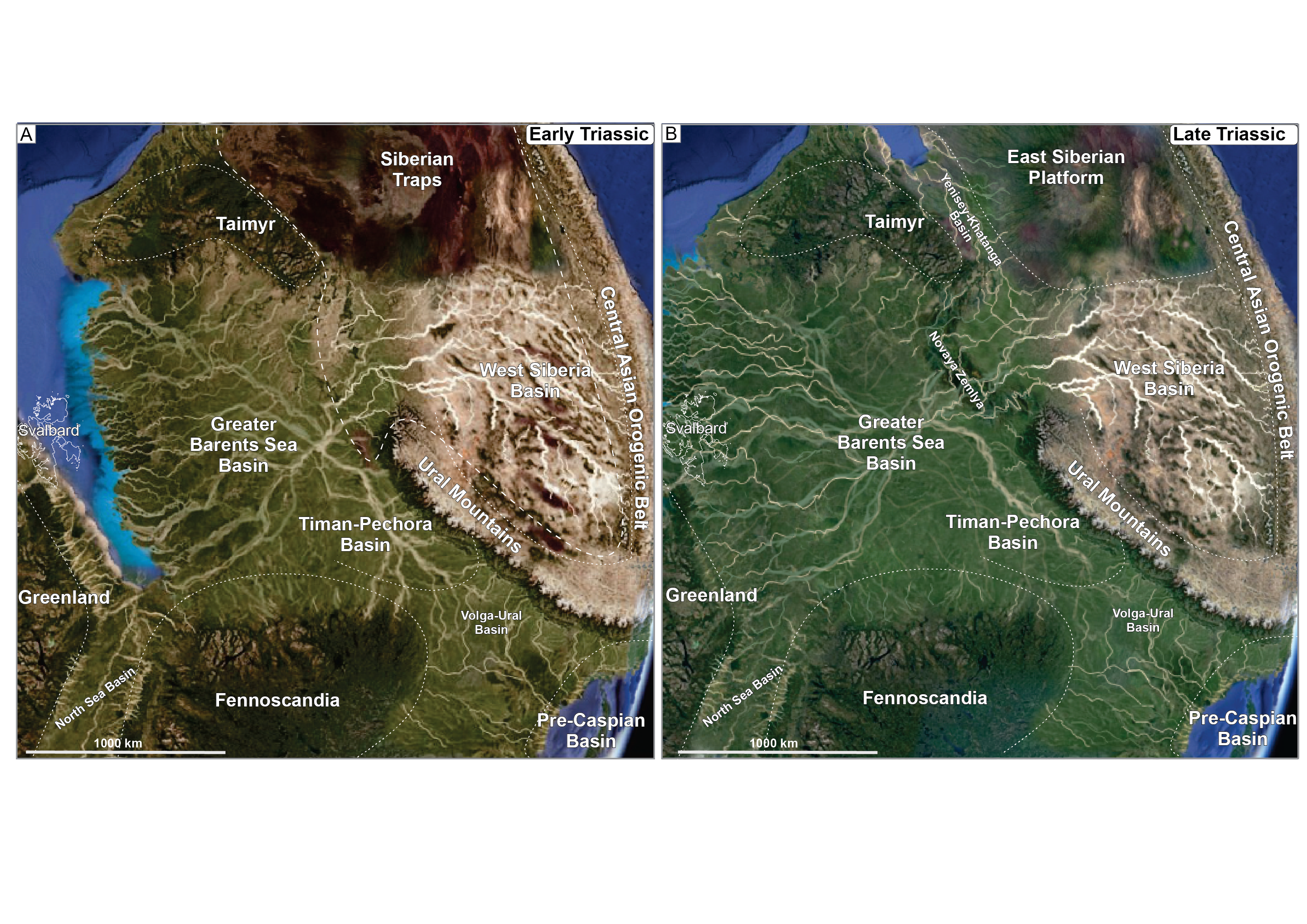
EGI’s Tony Doré has been cooperating with a team of researchers led by Dr. Albina Gilmullina of Bergen University, Norway, to look into Triassic sedimentation rates and patterns in the Barents Sea. The results were published in the GSA Bulletin this year.
During the Triassic, this remote Arctic province saw the emplacement of a thick and extensive Triassic succession – up to 4.5 km thickness over an area of quarter of a million km2 (more than ten times the area of the UK). The sediment loads are larger than that of any other known river, past or present, and comparable with the entire output of rapidly eroding continental margins like the southern Himalayas.
Why we did it
The Triassic is an important economic unit in the Barents Sea, containing both source and reservoir facies. In addition, the anomalously high sedimentation rates at the beginning of the Triassic, and later in the period, record a major global upheaval and one of the most radical episodes of climate change and extinction in the Earth’s history. Understanding this succession has relevance to modern-day climate change, and to understanding high-output depositional systems through geological time. The scale of the Triassic depocenter has direct relevance to the paleogeography of the Arctic at a time before the present-day Arctic Ocean existed.
What did we do?
Observational data on the Barents Triassic section from seismic and wells were combined with statistical modelling of source and catchment areas, to determine sediment flux through time, and the scale of the probable provenance area. The results were compared with modern day river systems, for example those supplied by rapidly-eroding orogens.
What did we find?
- During the Early Triassic, sediment supply was at its peak. It was larger than that of the biggest modern-day river systems, and comparable to modern-day margins supplied by tectonically active orogens.
- The Middle Triassic sediment load was significantly lower but still comparable to that of the top 10 largest modern rivers.
- During the Late Triassic, sediment load again increased significantly.
- Significant bypass took place, particularly during the Late Triassic, meaning that sediments from the eastern source area will have been distributed more widely in the greater Arctic.
Highlights
- The Early Triassic sediment supply was a direct and indirect result of emplacement of the Siberian Traps Large Igneous Province, the most extensive known volcanic episode in earth’s history.
- This event caused reactivation and uplift of both cratons and adjacent orogens, and a global temperature increase that probably led to the collapse of most onshore vegetation, leading in turn to extreme weathering and runoff into the adjacent seas.
- Triassic sediments in the Greater Barents Sea have typically been attributed to erosion from the developing Ural mountain chain. However, the sediment supply was so large that a much bigger provenance area is needed. The area probably included large parts of what is now the huge West Siberia Basin and the East Siberian platform.
- A follow-up paper, in the late stages of production, will demonstrate the signature and significance of this episode in the wider Arctic area.
Abstract
Triassic strata in the Greater Barents Sea Basin are important records of geodynamic activity in the surrounding catchments and sediment transport in the Arctic basins. This study is the first attempt to investigate the evolution of these source areas through time. Our analysis of sediment budgets from subsurface data in the Greater Barents Sea Basin and application of the BQART approach to estimate catchment properties shows that (1) during the Lower Triassic, sediment supply was at its peak in the basin and comparable to that of the biggest modern-day river systems, which are supplied by tectonically active orogens; (2) the Middle Triassic sediment load was significantly lower but still comparable to that of the top 10 largest modern rivers; (3) during the Upper Triassic, sediment load increased again in the Carnian; and (4) there is a large mismatch (70%) between the modeled and estimated sediment load of the Carnian. These results are consistent with the Triassic Greater Barents Sea Basin succession being deposited under the influence of the largest volcanic event ever at the Permian-Triassic boundary (Siberian Traps) and concurrent with the climatic changes of the Carnian Pluvial Event and the final stages of the Northern Ural orogeny. They also provide a better understanding of geodynamic impacts on sedimentary systems and improve our knowledge of continental-scale sediment transport. Finally, the study demonstrates bypass of sediment from the Ural Mountains and West Siberia into the adjacent Arctic Sverdrup, Chukotka, and Alaska Basins in Late Carnian and Late Norian time.
Reference
Gilmullina, A., Klausen, T.G, Doré, A.G., Rossi, V.M., Suslova, A, & Eide, C.H. 2021. Linking sediment supply variations and tectonic evolution in deep time, source-to-sink systems—The Triassic Greater Barents Sea Basin. Geological Society of America Bulletin, https://doi.org/10.1130/B36090.1.

Energy & Geoscience Institute
423 Wakara Way, Suite 300
Salt Lake City, UT 84108
801-581-5126